the Nawn Factory development process
the neighborhood
Roxbury historically has seen significant decline as the neighborhood has not received investment to match the rest of the city of Boston. It is the geographic center of the city, but still home to among the greatest minority population, the lowest median income and the highest ratio per capita of youth to adults. After the closure of the homeless shelter 1 on Long Island in Boston Harbor, it is also the neighborhood where those struggling with homelessness established a temporary camp near Boston Medical Center 2 .
Due to its central location, Roxbury is also the site of the busiest bus terminal in the MBTA transit system 5 but has few local amenities to entertain the level of traffic that it sees. Washington Street in Roxbury has a handful of single story liquor, shoe and convenience stores, but has not lived up to its potential as the rest of the city has developed around it.
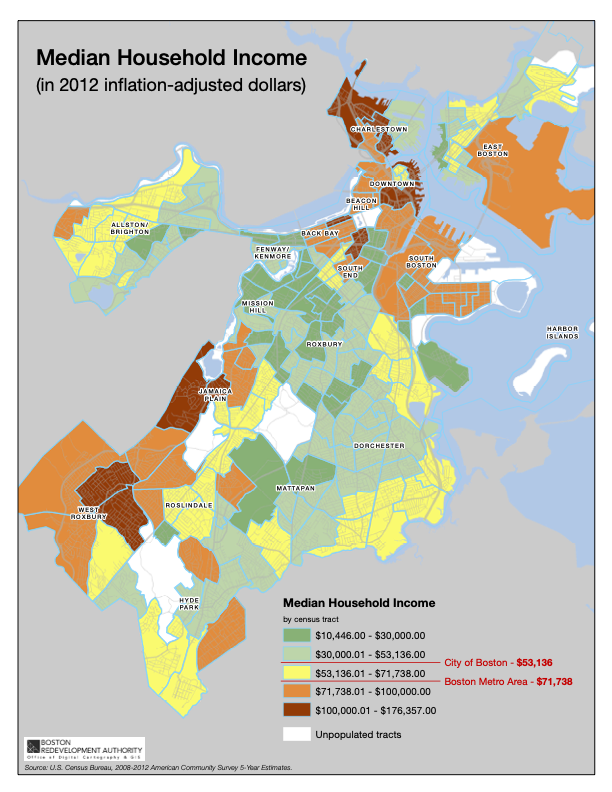
The map breaks out median household incomes by district, and points to a concentration of the lowest two income quintiles in Allston, Mission Hill, Roxbury, Dorchester and Mattapan.
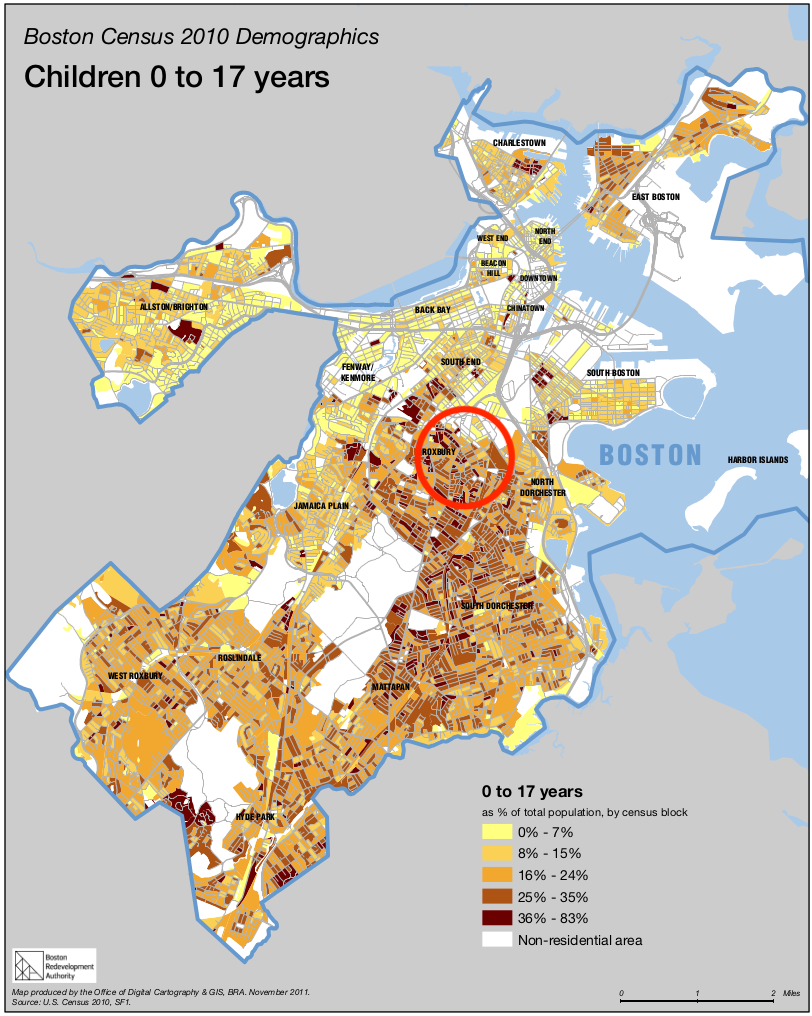
The census demographic map shows a concentration of families with children, and a higher per capita ratio of children in Roxbury, Dorchester, Mattapan and Hyde Park.
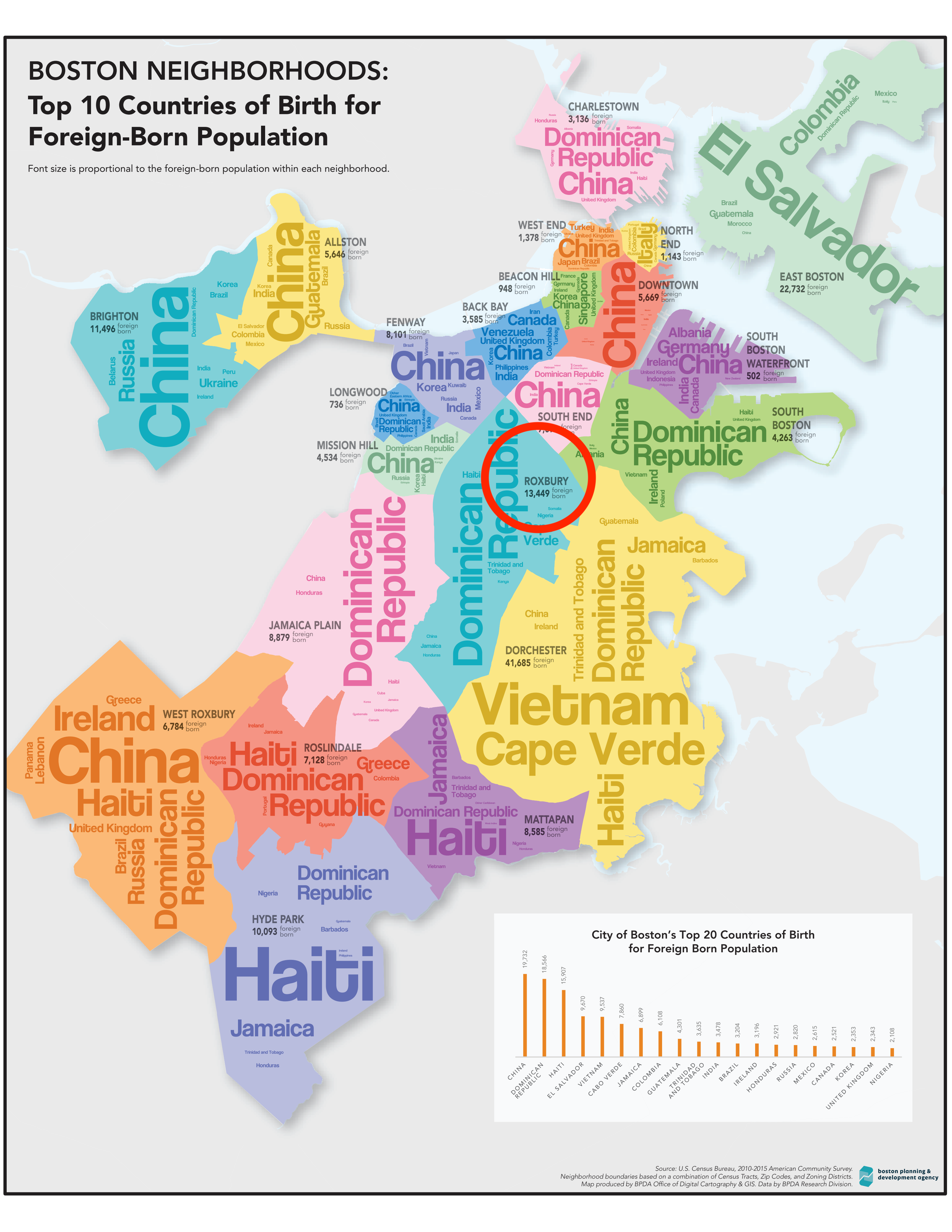
The city map shows a count of foreign born residents by neighborhood. The highest raw numbers of foreign born residents are in Dorchester, East Boston and Roxbury in that order.
the building
The Nawn Factory redevelopment represents 20 years of coordinated activism and effort by the residents of Roxbury to change the character of their neighborhood. With the help of Boston city government, the Roxbury Strategic Master Plan Oversight Committee 3 has realized a plan to activate vacant city owned properties in the neighborhood, and put them to productive use.
The Nawn Factory more specifically has sat abandoned for over 50 years. It is a historic building, built in the late 1800s, that was originally the headquarters of Owen Nawn 4 , a local contractor who built portions of the Boston transit system. It has served many uses since then, but fell into abandonment and disrepair over time. The vacant building suffered repeated vandalism and fire damage leading up to 1995; much of it was demolished, leaving the empty building envelope that stands today.
The RSMPOC has selected Jonathan Smalls as the developer for the Nawn Factory after a public review process based on the communities desire to activate the building, and bring more enrichment to the neighborhood.
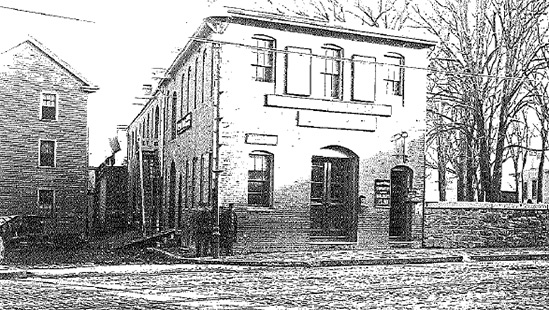
The brick building we know today was built on the site of a wooden Morocco leather factory. Its first use was as the business headquarters of Owen Nawn, a local contractor.
The historic building can be seen amongst a complex of wooden tenement houses along what was known as Nawn Street. None of those building survived, however recent archaeological efforts have uncovered their foundations and evidence of the people they hosted.
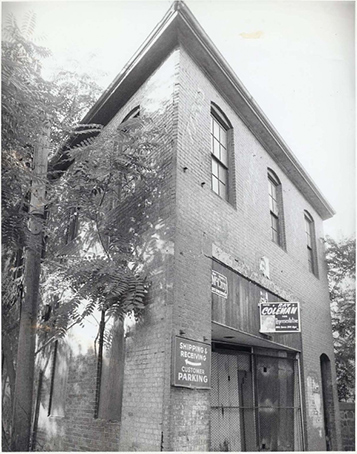
Through the 20th century the building hosted a number of local businesses. The modern building shows evidence of cigar manufacturing and auto parts retailing as examples.

After years of neglect, squatters and periodic fire damage, local inspectors recommended fully razing the structure. In 1995, the Massachusetts Department of Environmental Protection filed to demolish the most deteriorated rear portion, while preserving the street frontage as much as possible. As of 2020, that portion was all that was left standing. It was small and modest, but showed promise of what a revitalized building could be.
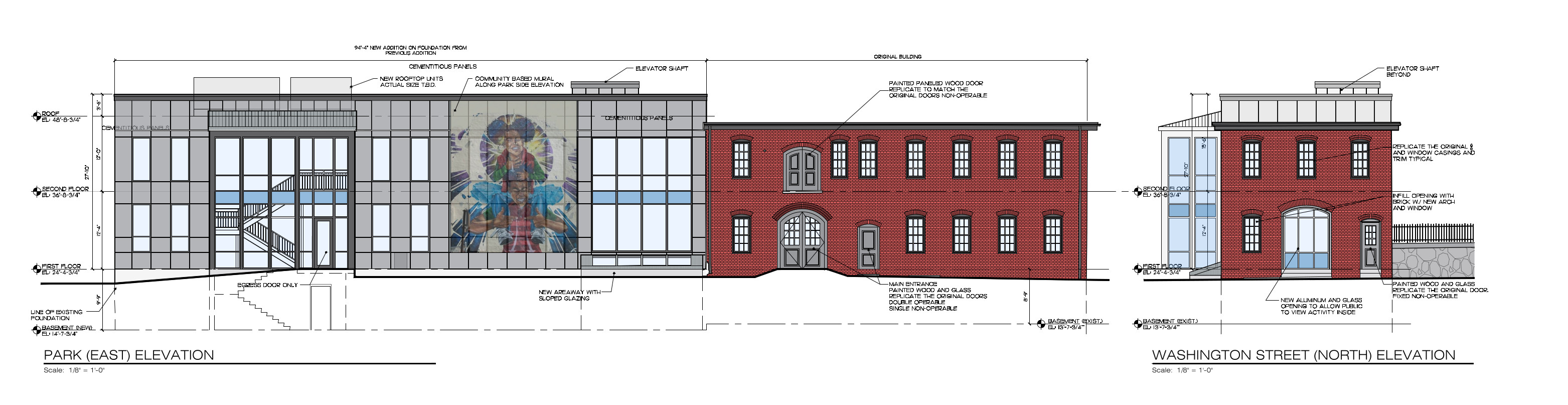
We went through several iterations of the design to create the right blend of modern and historic. The process involved stakeholders in the community, the whole gamut of city agencies, and state and federal historic review. Ultimately we struck a balance where the historic building was preserved and honored while breathing new life into the whole footprint of the building.
the impacts
MWBE representation
Supporting minority and woman owned businesses was at the forefront of our process from the very beginning. We placed special emphasis on interviewing and hiring MWBEs where possible.
As of writing in 2025, we also want to add that a number of fields had few minority candidates for us to consider, and that limited how much representation we could bring into the project. While the team we ultimately hired did an excellent job in delivering a remarkable final product in this specific project, we still encourage new entrants into the industry to address these gaps more generally; and so want to call out some of the affected fields:
- civil engineer
- structural engineer
- land surveying
local business and job creation goals
Development is inherently a local activity, which makes it very easy to support local businesses. However we also wanted to provide more insight into what communities our development team represents, and how data like this can better inform local job creation goals.
Some of our goals for local business support and job creation were based on the Boston Residents Jobs Policy 8 , which emphasizes employment of Boston residents with wage and scheduling standards. At least in predevelopment, all of the jobs were existing and retained rather than created. Most of the firms we hired were small, founder led teams based in suburbs around Boston. Based on the nature of the work, these were necessarily skilled and appropriately paid white collar jobs.
| MWBE | other | total | |
| participation | 4 | 6 | 10 |
| 40% | 60% | ||
| contract value | 28% | 72% |
For our search, we relied on self certified MWBE organizations as listed in the Massachusetts Search Directory of Certified Businesses 6 and Boston Certified Business Directory . We searched and contacted businesses in the fields that we needed to hire at the time, giving preference to those with an active web presence or a listed email address. Once we had established positive contact, we evaluated MWBE and other candidates equally based on merit.
| city | state | federal | total | |
| participation | 0 | 3 | 4 | 7 |
| 0 | 43% | 57% | ||
| contribution | 0 | 61.5% | 38.5% |
At the Nawn Factory development team, we feel very strongly that public subsidies are your tax dollars at work. We all pay taxes to see enrichment and public goods that none of us could afford privately.
Our project was able to take advantage of a number of public programs to help with the development cost of restoring this historic resource. We have included a break down of how public agencies applied your tax dollars to your community.
It is worth noting that Boston local government not only made no meaningful contributions to support the project, but actually blocked an additional source from Massachusetts state government. This award was made and announced 7 before voters had formally selected ILYB LLC as the developer for the project. This suggests that there was some break down in Boston city government in applying this funding to productive use once the selected developer was known.
| city | count | percentage | |
| 1 | 10 | ||
| Billerica, MA | 1 | 10 | |
| Boston, MA | 3 | 30 | |
| Reading, MA | 1 | 10 | |
| Southborough, MA | 1 | 10 | |
| Syracuse, NY | 1 | 10 | |
| Westford, MA | 1 | 10 | |
| Winchester, MA | 1 | 10 |
Compensation for most jobs in predevelopment is defined by competitive salaries in their respective industries: surveying, architecture and engineering are examples. The Boston Residents Jobs Policy (BRJP) seems to be directed more toward construction and retail jobs, so was not directly applicable during our predevelopment period.
The BRJP standard however was a good guide into what is seen as fair compensation for in Boston. While the development team did not directly create jobs during the predevelopment and construction phases of the project, we have committed to carrying this standard forward into the commercial operation of the Nawn Factory building.
the conclusion
The Nawn Factory redevelopment was a publicly commissioned project. As such, we feel that the public deserves visibility into the process and the result so that we as voters can make informed decisions about where we make investments. At a high level, the development team feels that there are three major areas for improvement:
-
local government investment
The development team feels that state and federal government advertised programs, and awarded support based on how well a project supported those goals in a very straight forward and accessible way. However local government in the city of Boston similarly advertised programs, but consistently across multiple departments and multiple funding years rejected all levels of financial and administrative support from small to large.
This is fine if such rejection reflects the will of the tax payers, but otherwise may indicate a disconnect between the intention of the voters who pay taxes and explicitly choose to advance a project through a democratic process; and the execution of the civil servants charged with supporting that effort. -
minority and female representation in some fields
Although we made a concerted effort to prioritize minority and women owned businesses throughout this project, we struggled to find and connect with such vendors in some fields.
The team does not include in our MWBE count any firms which seemed to nominally qualify as MWBE through their legal structure, but also still clearly had operational leadership that would otherwise not qualify. -
activation of underused spaces
The needs of a community evolve with time, however local residents and local government can respond to those needs more quickly and more progressively. The fact that a vacant property could persist for so long indicates that there are significant barriers to opening publicly owned space for public use. Spaces can evolve from community gardens to parks to residences and businesses through time rather than leaping from bare gravel to finished structures.
Such a transformation is impressive where it takes place, but also leaves significant geographic gaps in use of the public sphere until such a transformation happens.
Do you have questions about the project or the content of this report? Get in touch at theProject@theNawn.org. We love to talk about our work, and hope that this information can lead lead to more successful, community driven projects in the future.
Jon Smalls is the director of art @ the Nawn. He is passionate about the role the Nawn plays as a community organization, and focuses on art as enrichment but also art as a tool for civic engagement and social expression.
He is always up to talk about music, the communities he loves, and his latest library holds. Follow him and his writing for more dry humor blended into hot takes on life in the big city.
more by this author- "Ripple effects continue 10 years after Boston's Long Island Bridge and shelter, treatment programs closed" WBUR 2024 October 8 2026 April 24 https://www.wbur.org/news/2024/10/08/long-island-bridge-shelter-boston-10-years
- "Boston announces new plan to rid city of homeless encampment, get residents help" AP News 2023 August 25 2026 April 24 https://apnews.com/article/d59d3739910566f96d50d72e2ad476c0
- "Roxbury Strategic Master Plan | Bostonplans.org" City of Boston 2026 April 24 https://www.bostonplans.org/planning-zoning/planning-initiatives/roxbury-strategic-master-plan#past-meetings
- "Owen Nawn Factory" Right Here in Roxbury Wiki 2026 April 24 https://roxbury.fandom.com/wiki/Owen_Nawn_Factory
- "Nubian | MBTA" MBTA 2026 April 24 https://www.mbta.com/stops/place-nubn
- "Search Directory of Certified Businesses" Commonwealth of Massachusetts 2026 April 24 https://www.diversitycertification.mass.gov/BusinessDirectory/BusinessDirectorySearch.aspx
- "MassWorks 2019 Awards" Commonwealth of Massachusetts 2026 April 24 https://www.mass.gov/info-details/massworks-2019-awards#:~:text=Nawn
- "Boston Residents Jobs Policy" City of Boston 2025 October 10 2026 April 24 https://www.boston.gov/government/cabinets/equity-and-inclusion-cabinet/supplier-diversity/boston-residents-jobs-policy-construction-projects